ACT 1 --- The Boundary Moves
Robinhood launched Agentic Trading on May 27, 2026. By July 29, the company reported that nearly 100,000 customers had opened Agentic Trading accounts, with more than $100 million in Assets Under Custody.
The number is small. What it signals is not.
For most of the last twenty years, a trading platform was built around a simple relationship.
The platform showed you information.
You made the decision.
The platform executed the trade.
That relationship is changing.
AI is moving from helping investors find information to helping them interpret it, make decisions and, increasingly, take action.
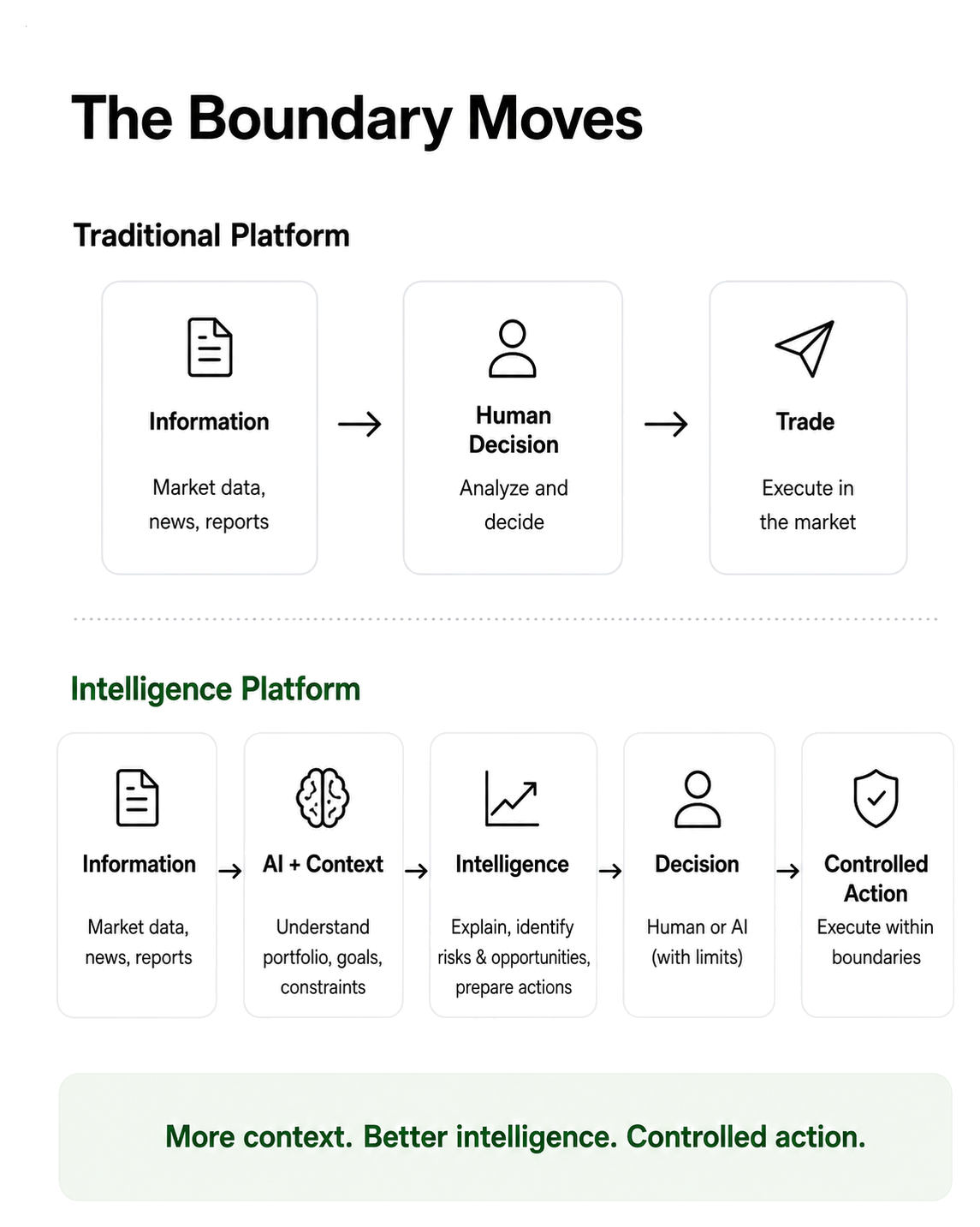
Robinhood is already moving in this direction. The nearly 100,000 customers with more than $100 million in AUC is still a small share of its overall customer base, but it shows that autonomous trading is no longer just an idea. It is already being used.
Interactive Brokers is taking a different approach. Its AI tools can help investors research and work with market information, while its platform allows customers to connect AI tools such as ChatGPT, Claude, Grok and Perplexity to their accounts and generate trade instructions. The customer reviews and submits every order. See: IBKR AI Integrations and IBKR AI Hub.
Robinhood is moving that boundary closer to autonomous action.
IBKR is keeping the customer closer to the final decision.
Both approaches make the same underlying bet: that AI can provide enough useful judgment to justify giving it a place inside the trading workflow.
How much authority should we give AI when the thing it is helping us control is a live financial market?
ACT 2 --- Who Holds the Button?
The difference between these platforms is not simply about features.
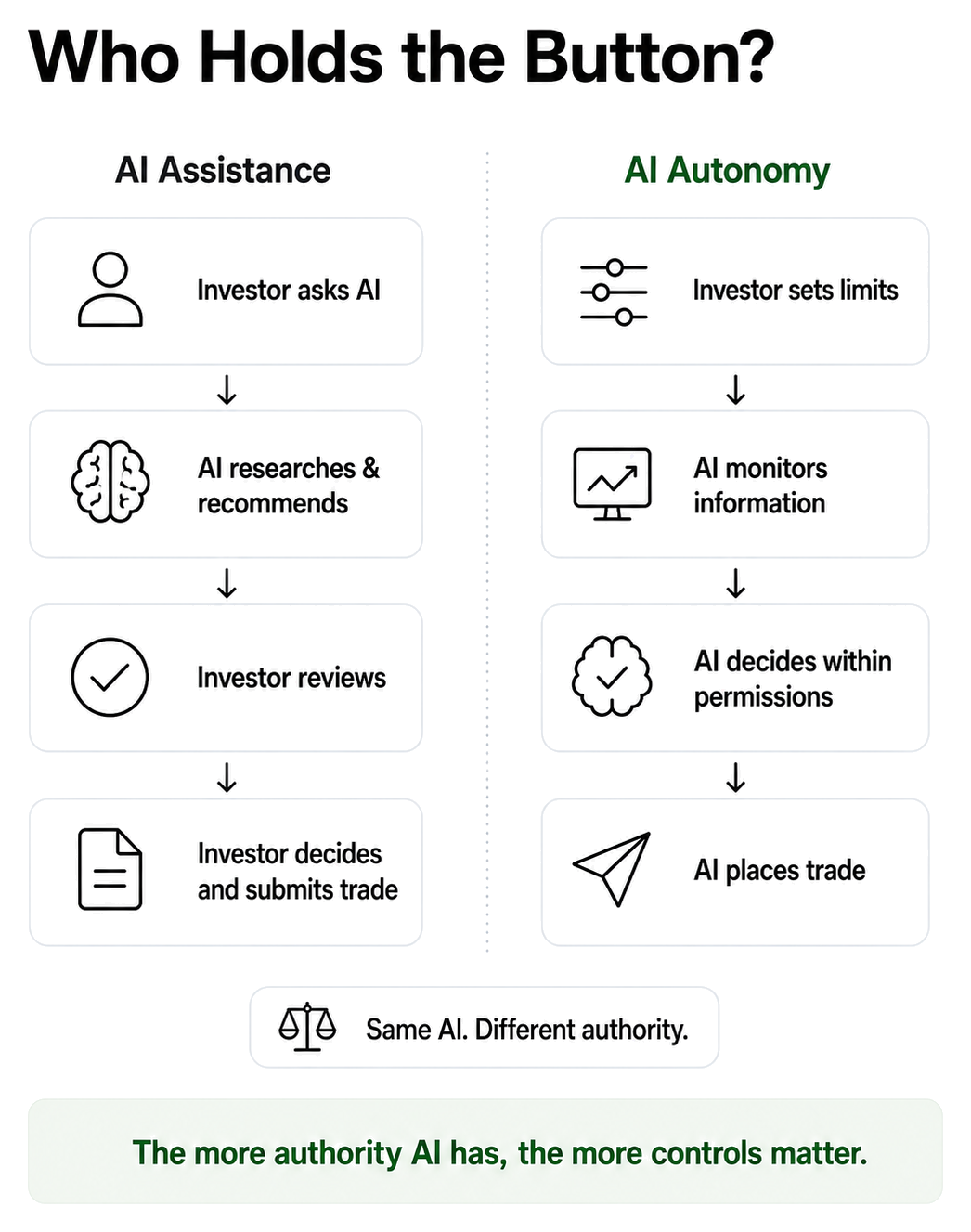
Different approaches. Same direction: AI is moving closer to the trading workflow.
It is about control.
Imagine two investors using AI.
The first asks the AI to research a company, explain what is happening and recommend a trade. The investor reviews the recommendation and decides whether to act.
The second gives an AI agent permission to do more. It can monitor information, make decisions and place trades within the permissions the investor has given it.
Both investors are using AI.
But they are not giving AI the same authority.
AI assistance and AI autonomy are not the same thing.
The more authority we give a system, the more important the controls around that authority become.
What happens when AI moves from helping us make a decision to actually making the decision?
ACT 3 --- The Trust Test
AI can process more information than a human can.
It can work quickly. It can connect information from different sources.
It can analyze things that would take a person hours to review.
But trading is not simply an information-processing problem.
Markets are uncertain.
A model can be right many times and still be wrong when the environment
changes.
When should we trust the machine enough to let it act?
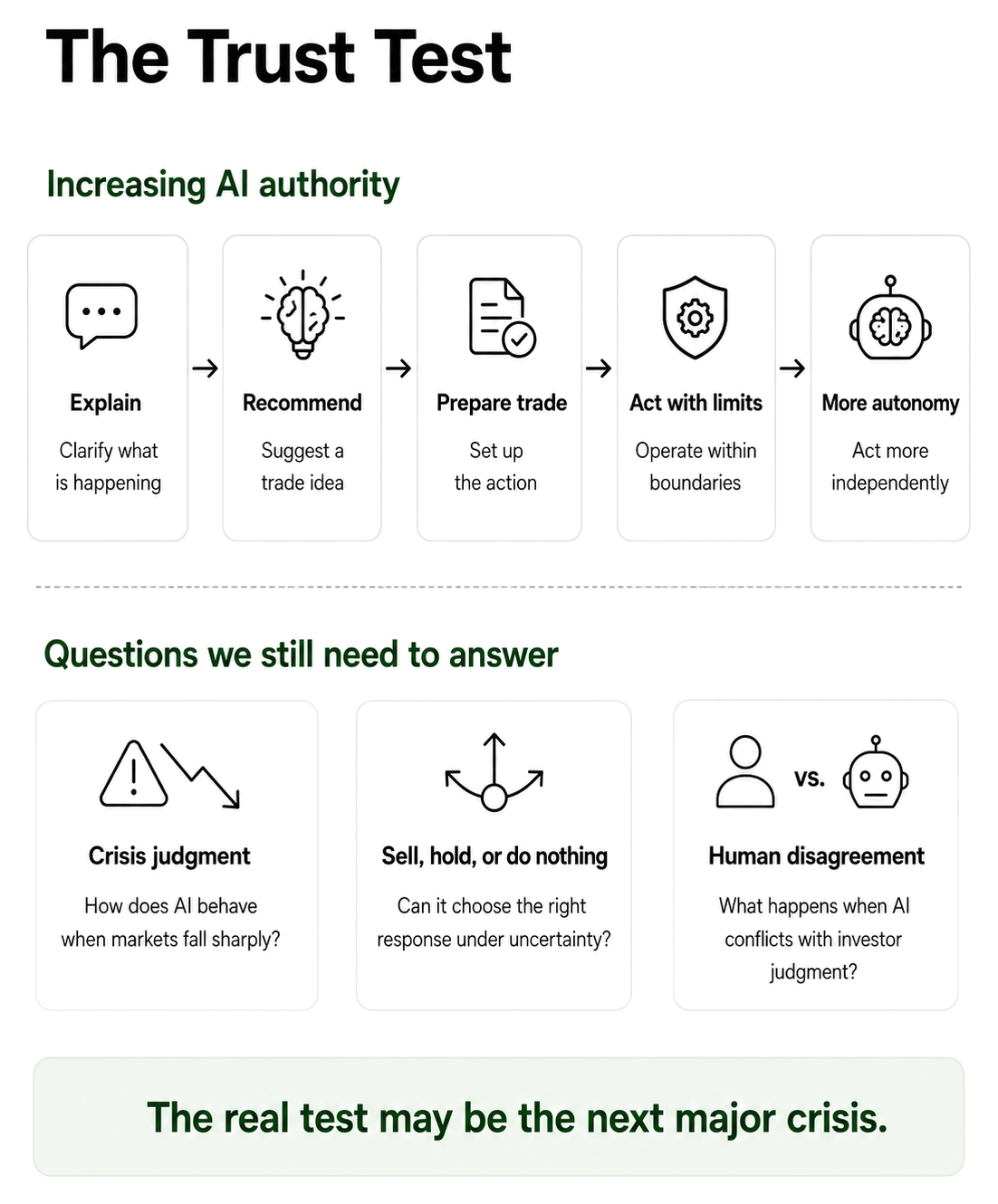
Authority increases as AI moves closer to action.
The real test of AI trading may not be the next bull market.
It may be the next major crisis.
Successful AI trades during a rising market may tell us that AI can process information and identify opportunities. But what happens when markets fall sharply?
Does AI know when to sell?
Does it know when to hold?
Does it know when to do nothing?
Can it recognize an unusual crisis early?
What happens when its recommendation conflicts with the investor's own judgment?
We simply do not have enough evidence yet to answer these questions.
That is not a prediction that AI will fail.
It is a question we need to answer through experience.
The amount of authority we give AI also matters.
We could ask it to explain.
Then recommend.
Then prepare a trade.
Then act within defined limits.
And eventually, for investors who want it, act more autonomously.
The more authority we give the machine, the less direct control the human has.
And that raises another question.
What happens when it is not one AI making decisions, but thousands of them?
ACT 4 --- When Machines Meet Machines
Imagine this.
AI #1 sees bad earnings.
It sells.
AI #2 sees the same earnings.
It sells too.
AI #3 does the same.
None of them is trying to manipulate the market.
They may all be making reasonable decisions based on the information
available to them.
But together, their decisions could become the market event.
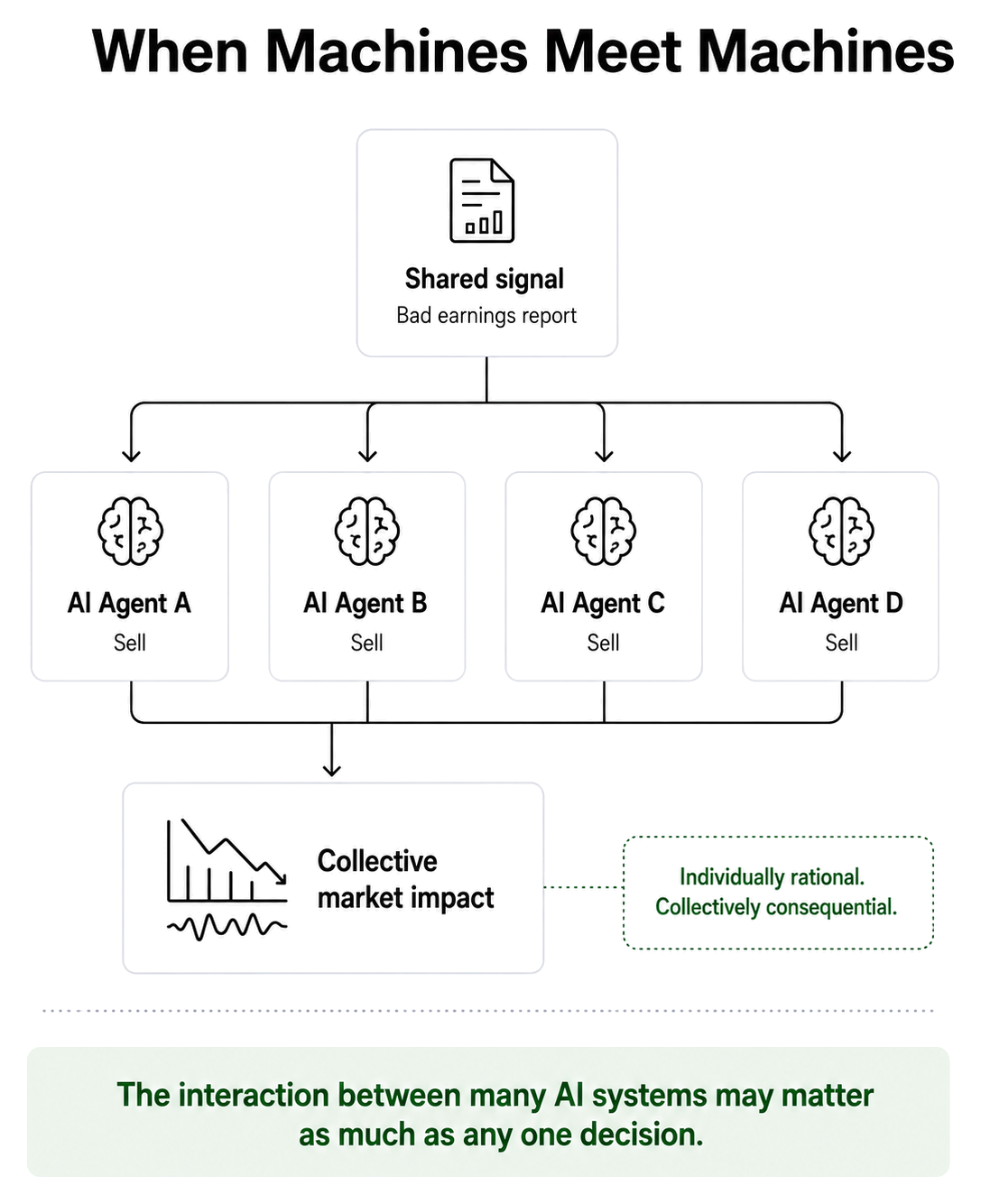
Individually reasonable AI decisions can collectively move the market.
That is why I think the interesting question is not really: AI vs. AI.
It is: What happens when AI systems start reacting to the same information and eventually to each other's actions?
FINRA has been cautious about AI agents and risks from increasing autonomy, including controls, oversight and auditability. See the FINRA 2026 GenAI report. The report identifies risks including autonomy, scope and authority, auditability and transparency, data sensitivity, domain knowledge, rewards and reinforcement, as well as continuing GenAI risks such as bias and hallucinations.
The research is still young, so we should be careful about making strong claims about how AI systems will behave when they interact at scale.
If thousands of AI systems are looking at similar earnings reports, economic data, news and market signals, they may reach similar conclusions.
And if enough of them act at the same time, the collective behaviour could matter just as much as the individual decisions.
That brings us to a problem that may be even more important than the AI's ability to make a decision.
How do we control it when something goes wrong?
ACT 5 --- When the Guardrail Breaks
Giving an AI permission to act does not mean giving it unlimited freedom.
Trading platforms can put controls around what an AI agent can do. It can have limits on the trades it can place, require approval before certain actions, keep a record of what it did and allow a human to intervene.
These controls are important.
But there is a difference between having a guardrail and knowing that the guardrail will work when something goes wrong.
What happens if the AI makes a decision that falls outside what the platform expected?
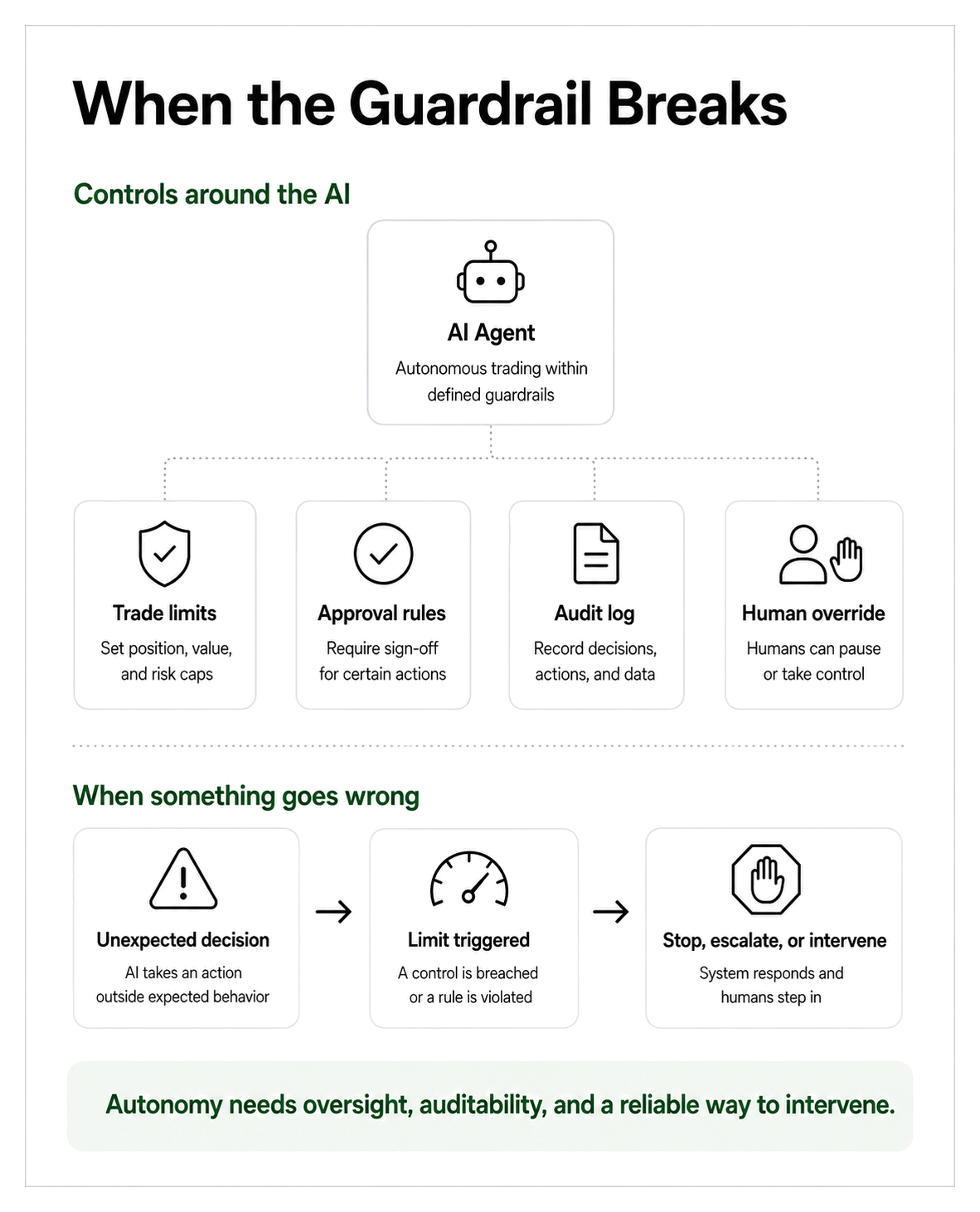
The AI does not control the control layer.
What happens if a limit is triggered?
What happens if the system misunderstands the situation but still
believes it is acting correctly?
Who pulls the plug?
A human?
The trading platform?
Another automated system?
And how quickly can that happen when markets are moving in seconds?
This is why autonomy cannot be designed on its own. It needs to sit alongside human oversight, auditability and clear limits on what the AI is allowed to do.
FINRA's 2026 report highlights these areas, including autonomy without human validation and approval, agents acting beyond intended scope and authority, and difficulty tracing or explaining complicated multi-step agent behaviour.
There is another problem that becomes harder as AI gets more autonomy.
Responsibility.
If an AI agent places a trade and loses money, who is responsible?
The investor who gave the agent permission?
The platform that provided the agent?
The company that built the AI model?
Or some combination of all three?
That is not just a legal question.
It is a product question.
If the customer is expected to accept the risk when the AI makes a decision, the customer needs to understand exactly what authority they are giving the system and what happens when something goes wrong.
Because a button that says "Let AI trade for me" is simple.
Designing everything that needs to happen after the AI makes a decision is much harder.
Can we trust the judgment behind the decision?
ACT 6 --- Information Isn't Judgment
AI can make information much easier to access.
It can read an earnings report, summarize news, compare financial results and bring information together in seconds.
What actually gives one investor an advantage over another?
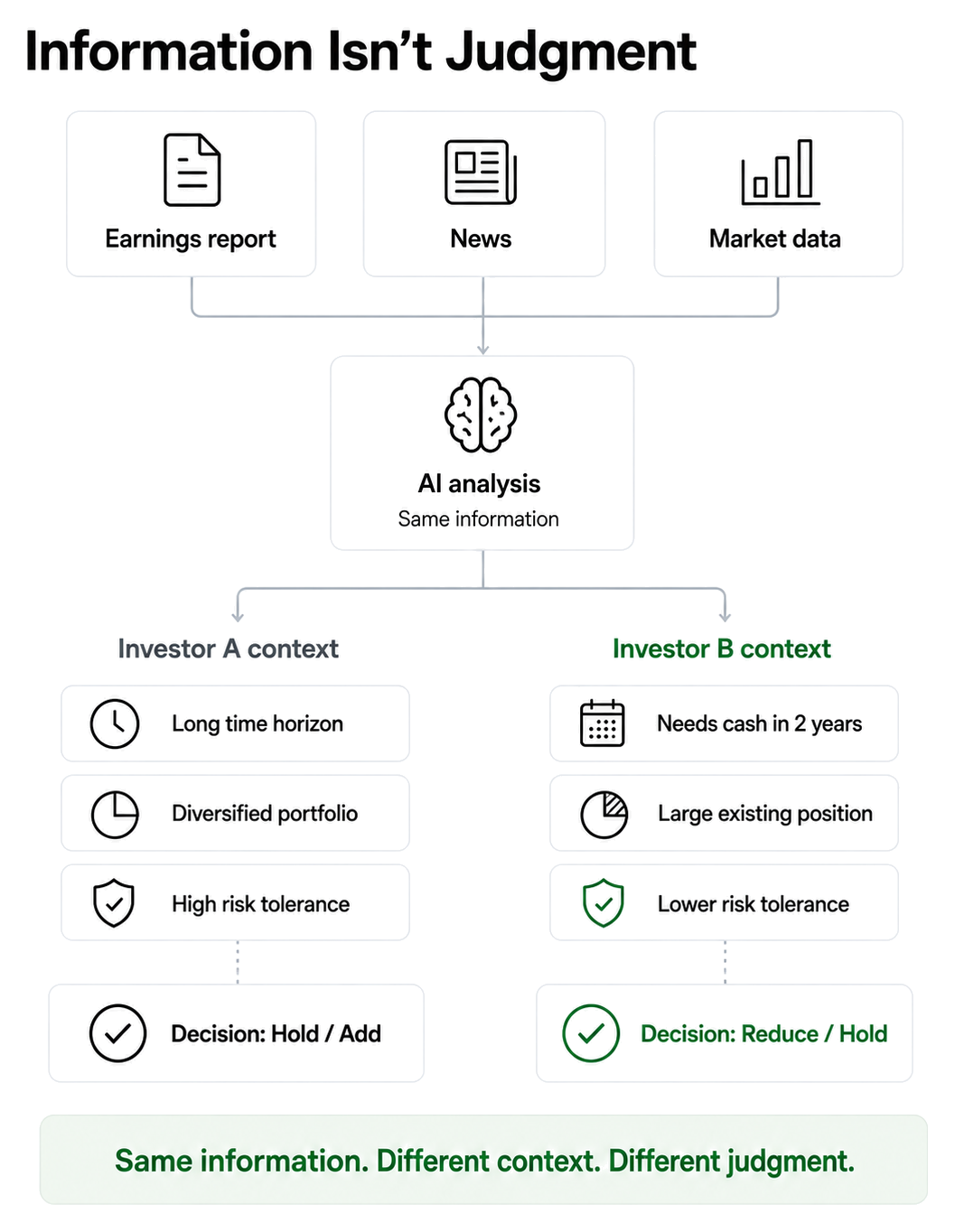
AI can improve how we process information. It cannot create information that does not exist.
Imagine two investors asking AI about the same company.
They have access to the same earnings report.
They can see the same market data.
They can ask similar questions.
The AI can process all of it much faster than either investor could.
Yet they can still arrive at very different decisions.
Because information is not the same as context.
An investor with a long time horizon, a diversified portfolio and a high tolerance for risk may look at the same earnings report very differently from someone who needs the money in two years and already has a large position in that company.
The information is the same. The context is not.
There is also a limit that AI cannot simply remove: information asymmetry.
If two investors have access to the same public information, AI may help both of them process it faster. But if one investor has better information, deeper industry knowledge or a better understanding of what is happening inside a business, the other investor cannot necessarily close that gap simply by using a better AI model.
AI can help you process the information you have. It cannot magically give you information you don't have.
There is another problem.
AI can interpret information incorrectly.
A model can misunderstand context, make an incorrect connection or confidently produce something that sounds right but isn't. It can also reflect biases in its training data, design or the way a question is framed.
That matters in investing because a wrong interpretation can lead to a very real financial decision.
If everyone is using AI to analyze the same public information, everyone may simply get faster at processing the same information.
If AI could predict markets with certainty, there would be no market left to predict.
The advantage may instead come from how well AI understands context, how reliably it interprets information and how effectively it works with the human making the decision.
If AI can gather the information, interpret it, recommend the action and eventually execute the trade, what exactly is the investor still doing?
ACT 7 --- The Human in the Loop
What happens to the human?
If AI can gather the information, interpret the news, analyze the portfolio, recommend a trade and eventually execute it, the investor's role starts to change.
The investor may no longer be doing all the research.
They may not even be making every individual decision.
Instead, they may be deciding what the AI is allowed to do.
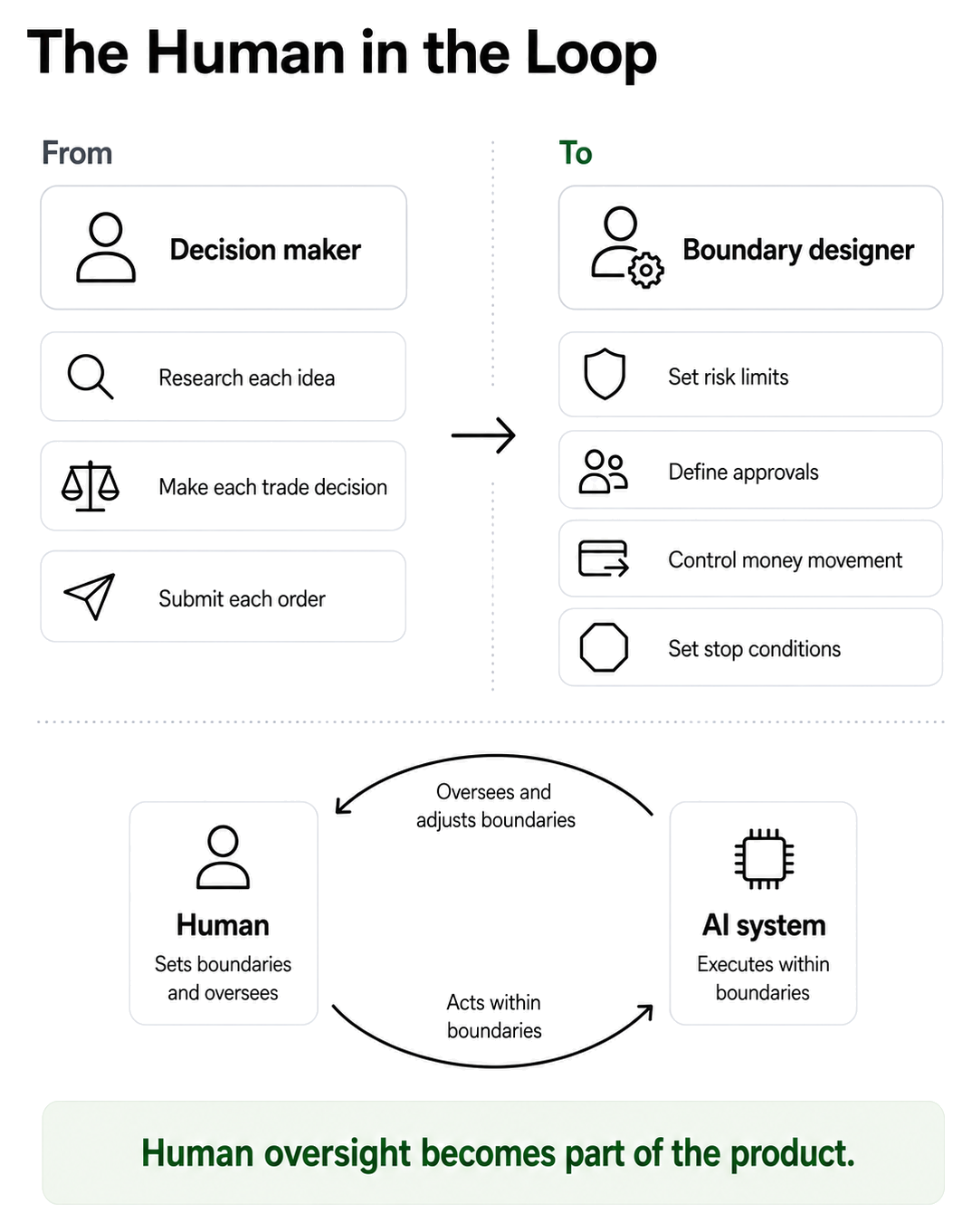
Control moves gradually as trust and capability grow.
What risks it can take.
How much money it can move.
When it needs approval.
And when it needs to stop.
The investor moves from making every decision to designing the boundaries within which decisions are made.
I think this is where human oversight becomes more than just a safety feature.
It becomes part of the product.
A good AI trading system should not simply ask: "Can I make this decision for you?"
It should also help the investor understand: "Why am I making this decision, what assumptions are behind it, and what happens if those assumptions are wrong?"
I don't think the answer is to keep humans involved in every single decision forever. That would defeat much of the value AI can bring.
Which decisions should remain human decisions, and which decisions can safely be delegated to machines?
That boundary may change as the technology improves.
But someone still needs to own the consequences.
ACT 8 --- The Authority Question
I don't think the answer is to keep AI out of trading.
The technology is already moving in this direction, and the potential benefits are real.
AI can help investors process information faster, understand complex data and make decisions with more context than they might be able to on their own.
The question is not whether AI belongs in the trading platform. It already does.
The more important question is how much authority we should give it.
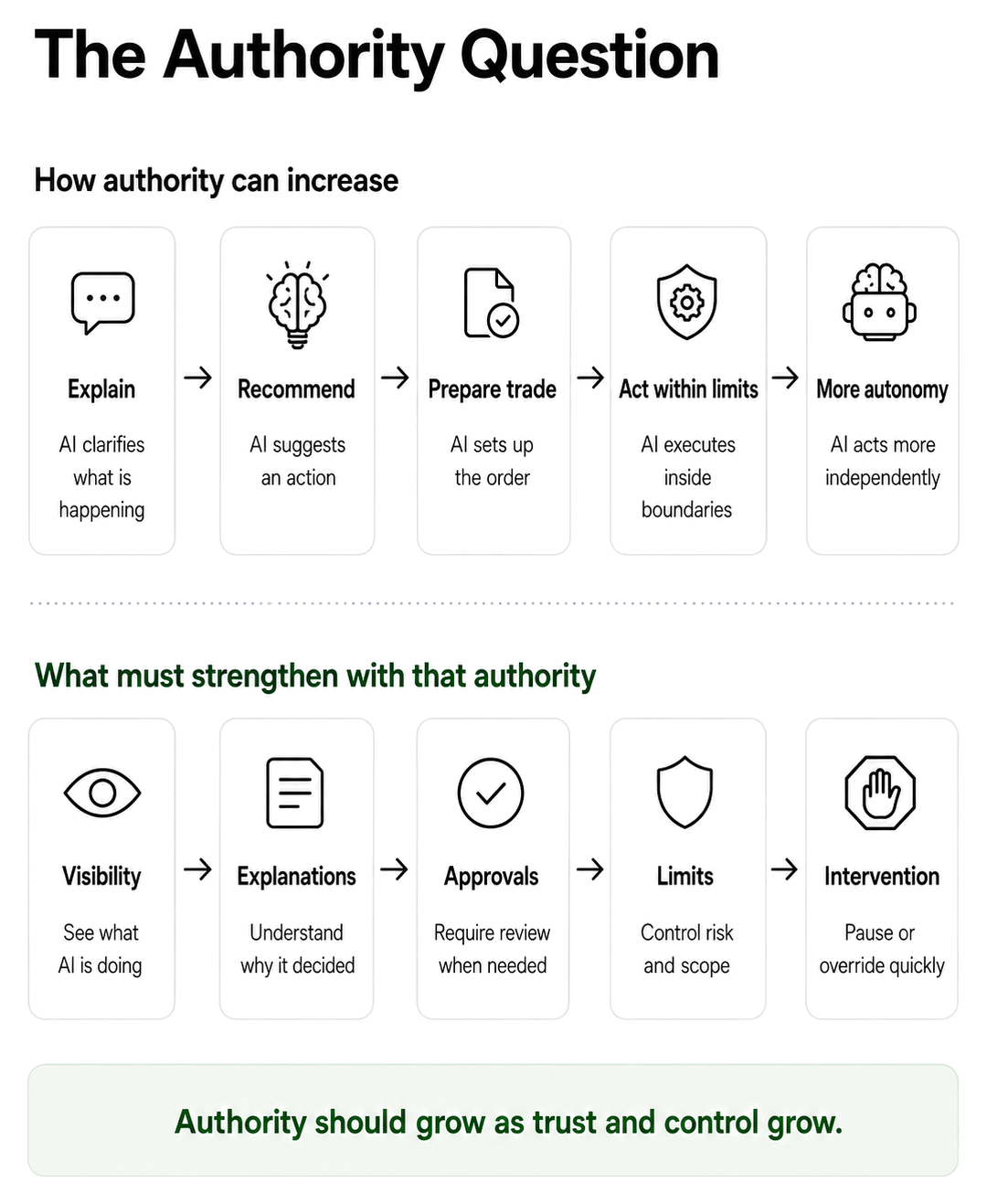
I would rather see platforms build systems where AI earns more authority as trust is established, rather than starting with maximum autonomy.
Let AI explain.
Let it recommend.
Let it prepare a trade.
Let it act within defined limits.
And, for investors who want it, eventually let it act more autonomously.
But every increase in authority should come with stronger controls, better visibility into what the AI is doing and a clear way for the human to intervene.
The goal should be to make the human better at deciding when to trust the machine.
We are still too early to know how AI will behave during a major financial crisis.
We don't yet know how multiple autonomous systems will interact at scale.
We don't know how much context AI will ultimately be able to understand, or how much advantage it can create when everyone has access to similar tools.
Those answers will come with experience.
Maybe AI will prove far more capable than we expect.
Maybe some of the risks will prove less significant than they appear today.
Or maybe we will discover that the hardest part was never making AI intelligent enough to trade.
It was designing how much control we should give it.
ACT 9 --- The Question We Can't Answer Yet
The adoption has already begun.
The questions around trust, autonomy, bias, hallucinations, guardrails and market behavior are still being worked out.
Maybe the future of trading isn't about giving AI more control.
Maybe it's about designing better ways for AI and humans to share control.
What happens when AI is no longer helping humans compete with other humans, but AI systems are competing with other AI systems?
Sources and direct reference links
- Robinhood: Agentic Trading launch, May 27, 2026
- Robinhood: Agentic Trading product page
- Robinhood: Q2 2026 results, nearly 100,000 Agentic Trading accounts
- Interactive Brokers: Agentic trading through Claude, June 1, 2026
- Interactive Brokers: ChatGPT and Grok expansion, June 22, 2026
- Interactive Brokers: AI Integrations
- Interactive Brokers: AI Hub
- FINRA: 2026 Annual Regulatory Oversight Report, GenAI
- FINRA: 2026 Annual Regulatory Oversight Report PDF